
 admin
He said prior to the fatal shooting he lodged safety complaints with union representatives and the film’s top safety official, assistant director David Halls, who pleaded no contest last year to a charge of negligent use of a deadly weapon and may be called on to testify.
“At times we seemed to be working at ludicrous speeds,” said Addiego, who also testified to the grand jury that indicted Baldwin in January. “We always seemed to be rushed and under the gun.”
In a tense cross-examination, defense attorney Jason Bowles asked Addiego whether he was aware that Gutierrez-Reed had unsuccessfully requested more time for focus on her responsibilities as armorer instead of other prop duties, such as rolling cowboy cigarettes.
“Did you ever stand up to Mr. Baldwin and say, ‘No, we’re not going to move this fast?’” Bowles asked.
“That’s not my job,” Addiego said.
Bowles continued: “With everybody else, grown men, not standing up to Mr. Baldwin, wouldn’t you find that difficult for her also?”
He noted that Addiego has sued Baldwin and Rust Movie Productions and questioned his motives in testifying.
“Are you hoping that you can come in and testify here today and something happens to Ms. Gutierrez-Reed and it will help your lawsuit?” Bowles asked.
“I’m hoping for justice, sir,” Addiego responded. “Two people where injured on a film set. That has affected not only me, that has affected the film industry.”
Also on Monday, prosecutors called on a series of FBI forensic experts in firearms, fingerprinting, gunpowder and DNA-evidence tracing to testify about their examination of a revolver and ammunition seized from the “Rust” set and an ammunition supplier to the film based in Albuquerque.
Prosecutors argue that Gutierrez-Reed is to blame for bringing live ammunition on set. They say six live rounds found on the “Rust” set bear identical characteristics — and don’t match live rounds seized from the movie’s supplier in Albuquerque.
Defense attorneys for Gutierrez-Reed have pointed out shortcomings in the collection of evidence from the set, and say that ammunition supplier Seth Kenney wasn’t properly investigated, and never submitted fingerprints.
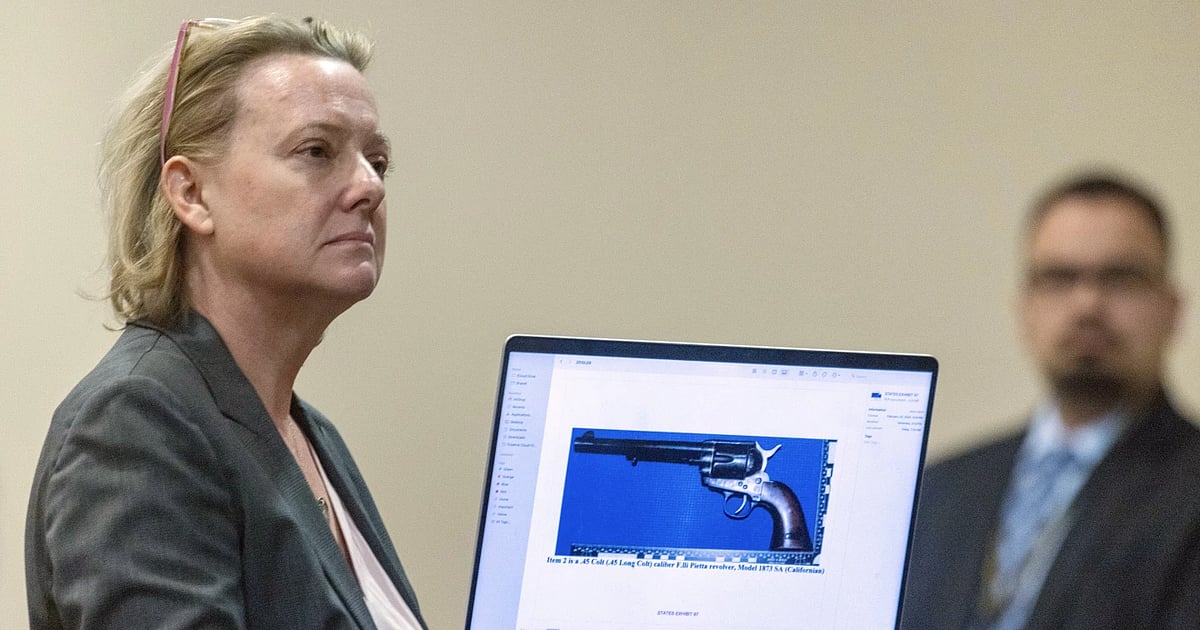
FBI firearms expert Bryce Ziegler testified about his analysis of a gun held by Baldwin in the shooting. He said the revolver and its safety features were fully functional when it arrived at an FBI laboratory for testing.
“When I received the firearm and I did an initial function examination, it did not appear that any of the safeties were malfunctioning or anything like that,” Ziegler said.
But Ziegler described additional “accidental discharge testing” on the gun in response to Baldwin’s assertions that the gun went off when he did not press the trigger. Ziegler said the only way he could get the gun to fire without pulling the trigger was by striking the gun with a mallet, knowing that it could break under the procedure and receiving permission to proceed.
“The function of that test is to see if I can get this firearm to fire without actually pulling the trigger,” Ziegler said.
“As I tested in my laboratory, it would not fire without pulling the trigger in the full-cocked setting, without being broken,” he said.
